Prior
to celebrating the New Heavens and New Earth, in the New Jerusalem, one final
negative scene must be considered—the Lake of Fire. It has now been more than three months since
I published my last blogpost, but I hated to replace it on my blog’s landing
page since it continued to receive hits.
As it turns out, in a timely fashion, I published the post entitled “The
Final Battle of History” on January 13th of this year. In it, I speculated concerning problems with
Russia, China, and Iran. Then, on
February 24th, Russia invaded Ukraine and the world has been
obsessed ever since with viewing the genocidal war crimes Putin has committed
(like Hitler, Stalin, Mao, and more recently, Muslim terrorists and Xi Jinping—although
we shouldn’t forget Planned Parenthood in our list of killers and atrocities). These entities, like the Beast and False
Prophet, may well be candidates for induction into the Lake of Fire. Russia has received support from China, as
both China and Russia have allied themselves with Iran. What I had written as “speculation” was
happening before our eyes. Unbelievably,
the Biden administration is still using Russia to negotiate a treaty with Iran
for us (which could threaten the very existence of Israel)! China is breathing out threats concerning
invading Taiwan and Iran is still breathing out threats about annihilating
Israel. Nevertheless, the blog series
must continue. We are nearing the end (I
mean the end of the blog series, not necessarily the world).

One might refer to the final negative scene of the Apocalypse as the ultimate “nail in the coffin of atheism.” As I point out on pages 6-7 of my book ArguMentor, the agnostic philosopher Kenneth Burke observes in Attitudes Toward History (p. 52-53):
Atheism
(and, in keeping, a categorical denial of immortality) is a statement of faith
that necessarily cannot be substantiated by a “weighing of all the
evidence.” When you find a man who is
exceptionally eager to deny the possibility of immortality (as though he “could
not rest” without a constant “secular prayer” to the effect that death is
absolute) you may legitimately grow quizzical of his intensity. Why such zest? Might it not come from a fear of punishment
after death? For it is obvious that, if
the possibility were either death or heaven, there would be no incentive for a
man to become engrossed in the denial of immortality. He would let the matter slide, content to
await his sojourn in paradise when it came, and to go about his business in the
interim. If, on the other hand, the
possibility of immortality contained for him the likelihood of his taking up
permanent residence in hell, he would have “good emotional reasons” for wanting
to “pray” immortality out of existence.
Hence, when we see a man who goes out of his way to amass evidence that
“proves” mortality, we should take his engrossment as a somewhat unwieldy and
roundabout way of cancelling guiltiness.
The man . . . who says
“absolutely not” is driven by . . . the fear of immortality (which could only
derive from a latent fear of hell that stimulated him thus indirectly to
“legislate” the possibility out of existence).
Therefore, before looking
toward the happy features of the world to come in the next blogpost, it is
fitting that this unhappy scene of the cosmic drama be first considered.

Judgment
Revelation
20:14-15 (NKJV) describes a judgment, just prior to the creation of the
new heavens and new earth: “This
is the second death. And anyone not found written in the Book of
Life was cast into the Lake of Fire.” Revelation 21:8 (NKJV)
elaborates: “[T]he cowardly, unbelieving, abominable,
murderers, sexually immoral, sorcerers, idolaters, and all liars shall have
their part in the lake which burns with fire and brimstone, which is the
second death.”
These passages are not John’s first discussions of the Lake of
Fire, however. According to Revelation
19:20, the first individuals to be cast into the Lake of Fire were the beast (understand: Nero) and the false prophet (understand: the Jewish high priesthood). This initial consignment to the Lake of Fire occurred
at least 1000 years before the Dragon/Devil/Satan was finally cast into the Lake
of Fire. Revelation 20:10 (NKJV) reports
that, after his 1000 years of incarceration in the Abyss, and after he raised
up Gog and Magog, only to see their destruction: “The devil, who deceived them,
was [THEN?] cast into the Lake of Fire and brimstone where the beast
and the false prophet are. And they will be
tormented day and night forever and ever.”

The Stream of Fire
In
Apocalyptic? #32, under my categorization of hapax legomena, I observed
that, prior to John’s Apocalypse, no one had ever used the expression “Lake of
Fire.” Nevertheless, Daniel had used the expression “stream of fire” (Daniel
7:10) and we are, therefore, able to logically deduce what John means by his
expression “Lake of Fire.” On page 72 of
Revelation: The Human Drama, I
comment:
For John, as for
other Jews of his generation, a concept of a whole from which parts spring up
and to which they return is the concept of the Nehar di-Nur (the "stream
of fire"). Louis Ginzberg
states: "Thus there are angels who
spring up daily out of the stream Dinur (='stream of fire'; comp. Dan. 7.10);
they praise God, and then disappear. Out
of every word uttered by God angels are created." Ginzberg says that the Rabbis further
connected this stream with at least one star:
"The stream of fire in which the sun bathes, is identical with the
Nehar di-Nur." An easy connection
would be to see other . . . "stars," bathing in and arising out of
the stream of fire, as well.
John equates “stars” with “angels” in
Revelation 1:20 (NKJV): “The seven stars are the angels of the
seven churches.”
Revelation 12:3-4 (NKJV), in an allusion to “fallen angel stories,”
describes Satan as: “a
great, fiery red dragon having seven heads and ten horns, and seven diadems on
his heads. His tail drew a third of the stars
of heaven and threw them to the earth.” As Revelation 12:9 (NKJV) continues, “So the great
dragon was cast out, that serpent of old, called the Devil and
Satan, who deceives the whole world; he was cast to the earth, and
his angels were cast out with him.”
On page 151 of Angels and Demons:
The Personification of Communication (Logology), I comment:
John is familiar
with the "stream of fire." He
does not mention this stream, but he describes a "Lake of Fire" into
which the Devil and his angels are thrown.
Not only is John familiar with the "stream of fire," he even
adds a twist to the concept: A “stream”
keeps on flowing, but a "lake" is the end of the line. Water flows into a lake, but does not flow
out. According to Ginzberg, later Jewish
writers speak of souls passing through the river of fire where "the
wicked" are "judged."
Whether these Jewish writers originated the idea of a river of fiery
judgment or picked up on John's "Lake of Fire" is uncertain, but
their concept does seem to demonstrate the ease with which fiery judgment and
the stream of fire may be connected.

Fiery Punishment
Matthew
25:31-46 (NKJV), while not using John’s “Lake of Fire” terminology, appears to
be discussing the same phenomenon, but he adds the notion that this everlasting
fire (Lake of Fire?) was actually “prepared for the devil and his
angels.” If the Lake of Fire was
PREPARED FOR THE DEVIL AND HIS ANGELS, it seems only appropriate that (after
the Beast and False Prophet), the first entity consigned to the Lake of Fire at
the end of history would be the Dragon/Devil/Satan—followed, of course, by “the
goats” (or, as Revelation 20:14-21:8 puts it: “anyone not found written in the Book of Life was
cast into the Lake of Fire . . . the cowardly, unbelieving, abominable,
murderers, sexually immoral, sorcerers, idolaters, and all liars.” “Death and Hades”
of 20:14 might be understood as either the devil’s angels (for example, the
Angel of Death) or the inhabitants of the abode of the dead (Hades) whose names
were not written in the Book of Life.
Matthew cites the words of Jesus:
“When the Son of Man comes in His glory . . . All the nations will be
gathered before Him, and He will separate them one from another, as
a shepherd divides his sheep from the goats. . . . Then the King will say to those on
His right hand, ‘Come, you blessed of My Father, inherit the kingdom prepared for you from the foundation of the world . . . Then He will
also say to those on the left hand, ‘Depart from Me, you cursed, into the everlasting fire prepared for the devil and his angels . . . And these will go away into everlasting punishment, but the righteous into
eternal life.”
Gehenna
Besides
calling this scene “everlasting fire” and “everlasting punishment,” Matthew
also refers to the scene as Gehenna. Although
John never uses this “Gehenna” terminology, I state on page 54 of my book The
Logic of Christianity: A Syllogistic
Chain:
The
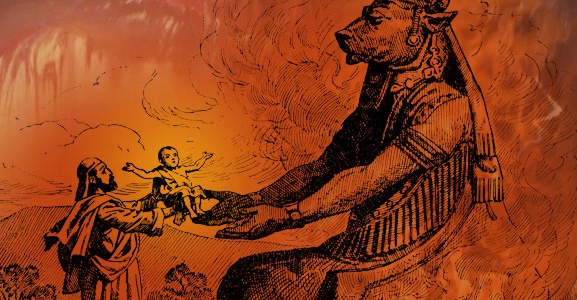
Hebrew word for Hell is Gē Hinnom (the Valley of Hinnom), the name of an area
outside of Jerusalem where apostate Israelites had sacrificed their innocent
children to the false god Molech. Due to
this SCANDALOUS practice of killing children, Gē Hinnom became a name that
forever after was considered cursed.
Hell in both Judaism and Christianity is referred to as the Valley of
Hinnom (Gehenna, in the Greek New Testament).
Jesus and his brother James do not always use the term
Gehenna as a place of torment to which humans will be sent. James 3:6 (NKJV), writing to Jewish Christians, refers to
Gehenna as the fiery source for the negative use of the tongue: “And the tongue is a
fire, a world of iniquity. The tongue is so set among our members that
it defiles the whole body, and sets on fire the course of nature; and
it is set on fire by hell (Gehenna).”
Matthew, also writing to Jewish Christians, uses the term more times
than does any other New Testament writer.
Luke and Mark, whose gospels are addressed more to Gentile Christians, each
use the term Gehenna in one instance only.
Luke 12:5, in reporting the same teaching of Jesus that Matthew 10:28
records, warns not to fear those who kill the body, but, instead, to fear Him who
has the power to cast into (i.e., destroy both soul and body in) hell
(Gehenna). Hell, here, certainly sounds
like a destination. Mark 9:43-47, in
reporting the same teaching of Jesus that Matthew 5:27-30 and Matthew 18:6-9 record,
recommends (using hyperbole?) cutting off your hand (or foot) or plucking out
your eye rather than having both hands, (feet,) and eyes to be cast into hell
(Gehenna). Here, hell also sounds like a
destination. Matthew 5 cites Jesus using
this teaching with regard to the issue of adultery and looking at a woman to
lust after her, while Mark 9 and Matthew 18 cite Jesus using the teaching with
regard to the issue of causing “one of these little ones who believe in me to
sin/stumble.” Mark repeatedly adds and
emphatically that the fire of Gehenna shall never be quenched.
To these two teachings of Jesus regarding
Gehenna, Matthew 5:22 (NKJV) adds, “[W]hoever says [to his
brother], ‘You fool (moron)!’ shall be in danger of hell fire” (another use that sounds like a destination). But, in another unclear use
of the term, Matthew 25:1-15 (NKJV) describes Jesus’
criticism of the scribes and Pharisees: “For they bind heavy burdens, hard to bear, and lay them on
men’s shoulders; but they themselves will not move them with
one of their fingers. . . . [they]
travel land and sea to win one proselyte, and when he is won, [they] make him
twice as much a son of hell (Gehenna) as [them]selves.”
Jesus’ comment in Matthew 16:18 IN THE KING JAMES VERSION that the
“gates of hell shall not prevail against” the Church translates as not Gehenna,
but Hades, as hell. The NKJV
corrects the translation.

Is Hell Annihilation or Unending Torment?
This
much seems certain: The fire of the Lake
of Fire (aka, Gehenna) is described as being permanent. Mark 9:43-47 repeatedly calls it an unquenchable fire. Matthew
25:31-46 refers to everlasting fire.
There is some suggestion that the fire, while unquenchable and
everlasting, may be the only part of the Lake of Fire/Gehenna that is
permanent. This thought leads some to
believe that annihilation is the result from being cast into the Lake of Fire. That interpretation will be discussed
shortly. Perhaps, John’s point, however,
is that there is never a return or release from being cast into the Lake of
Fire/Gehenna, whereas, the Dragon’s incarceration in the Abyss/Bottomless
Pit in Revelation 20:1-3 and 7 was only temporary (albeit, for one thousand
years). In Revelation 9:1-11, the plague
of locusts (see Apocalyptic? #28) emerged from the Abyss/Bottomless
Pit. In Revelation 11:7 and 17:8, the
Beast ascends from the Abyss/Bottomless Pit. If entities may, at some point, leave
the Abyss/Bottomless Pit, incarceration there is not permanent
consignment. One might also compare the
temporary torment of the Rich Man (vs. Lazarus) in Jesus’ parable (Luke
16:19-31). Luke 16:23 states that the
Rich Man was in Hades, not in Gehenna, but that he was, nevertheless,
experiencing fiery? torment. The term
here used for torment is from the same etymological root as John’s term for the
eternal torment of the Lake of Fire in Revelation 20:10. Nevertheless, since
John in Revelation states that Hades is cast into the Lake of Fire, Hades is
probably understood by John to be a temporary abode of the dead. Revelation 1:18 states that Jesus holds the
keys to death and Hades. The Lake of
Fire, on the other hand, even if torment is experienced in both it and in Hades,
is permanent.

What Constitutes Torment?
In the parable of the Rich Man and Lazarus, Luke 16:23(-28), the
Rich Man petitions Abraham to
“send Lazarus that he may dip the tip
of his finger in water and cool my tongue; for I am tormented in this
flame.” Despite the fact that this
torment is not permanent because it is in Hades—not in Gehenna or the Lake
of Fire—this is the closest parallel to Revelation 20:10 (NKJV) in which:
“The devil . . . was cast into the Lake of Fire and
brimstone where the beast and the false prophet are. And
they will be tormented day and night forever and ever.” Since the devil is a “celestial” entity,
Jesus’ assumed power to “torment” demons was posited by one claiming to be
demon-possessed in Mark 5:7, Luke 8:28, and
Matthew 8:29. There, the man who
believed he had a Legion of demons assumed that Jesus had the power to
“torment” the demons. Indeed, the
appearance is that, at least, the devil and his angels (plus the beast and the
false prophet) will be tormented forever.
Not all “torment” discussed
in the New Testament (or even Revelation) seems to be the variety in which
flames of fire cause the torment. According
to Matthew 4:24, Jesus healed those with diseases and “torments.” Matthew 8:5-6 reports that the centurion’s
servant was “tormented” by paralysis.
Matthew 14:24 and Mark 6:48 report that the disciples in their boat (on the
Sea of Galilee) were “tormented” by waves and the difficulty of sailing in
rough seas. In the Parable of the
Unforgiving Servant, Matthew 18:34 narrates that the unforgiving servant was
placed with the “tormentors” until he should repay all that he owed. In 2 Peter 2:8, Lot’s righteous soul was
“tormented” by seeing and hearing the filthy conduct of the wicked in Sodom.
In
Revelation 12:2, the process of giving birth was associated with “torment.” Women
who have given birth can empathize. In
Revelation 11:10, the two witnesses (Moses and Elijah/the Law and the
Prophets?) “tormented” those who inhabited the land of Israel. In Revelation
9:5, there was “torment” (but not death) inflicted by the plague of Locusts. Using Josephus, I explain this plague in Apocalyptic?
#28 as the rape of the land by Simon son of Giora in 69
A.D. In Revelation 14:9-11 (NKJV), those who worship “the beast and his
image . . . shall be tormented with fire and brimstone in the
presence of the holy angels and in the presence of the Lamb. And the
smoke of their torment ascends forever and ever; and they have no rest
day or night.” While this sounds as if
it might be Lake of Fire torment, the Lake of Fire is not mentioned here. Does this passage mean that the torment of
the Beast worshippers will last forever or does it just mean that “the smoke of
their torment” will ascend forever? Is
this the same smoke of their “torment” alluded to in Revelation 18:7-8, where
Jerusalem/Babylon’s “torment . . . will come in one day—death and mourning
and famine. And she will be utterly burned with fire.” These two passages sound similar
to Revelation 18:9-10 (NKJV): “the smoke of her burning . . . fear of her torment . . . ‘Alas,
alas, that great city Babylon, that mighty city!” (See also 18:15.) This specific torment of Jerusalem was
experienced in history (in 70 A.D.)—not in the Lake of Fire.


What Constitutes Everlasting Punishment?
Since
Matthew
25:31-46 (NKJV) quotes Jesus as promising to “say to those on the left hand, ‘Depart from Me, you cursed, into the everlasting fire prepared for the devil and his angels . . . And these will go away into everlasting punishment,” two things seem clear:
1.
The fire of the “Lake of Fire” is everlasting.
2.
Those
whom Jesus designates as “goats” will experience “everlasting punishment.”
What
is not quite as clear, however, is that the everlasting punishment of those
humans cast into the Lake of Fire will be an everlasting “torment.” John calls this everlasting punishment,
resulting from being cast into the Lake of Fire “the second death.” What that description means will be
considered, momentarily. Also
problematic is the Matthew
10:28 warning not to fear those who kill the body, but, instead, to fear Him who
has the power to “destroy both soul and body in hell (Gehenna).” If both soul
and body are “destroyed” in Gehenna, what sort of existence remains to be “tormented”
forever? Would the permanent personal
destruction of one’s body and soul be considered “everlasting punishment”?

The Second Death
Revelation
20:14-15 (NKJV) describes “the
second death,” the fate of “anyone not found written in the Book of Life [who]
was cast into the Lake of Fire.” Revelation 21:8 (NKJV) specifies:
“[T]he cowardly, unbelieving, abominable, murderers,
sexually immoral, sorcerers, idolaters, and all liars shall have their part
in the lake which burns with fire and brimstone, which is the second
death.” Revelation 2:11 assures the
faithful church at Smyrna that whoever overcomes will not be hurt by the second
death and Revelation 20:6 assures those who are part of the first resurrection
that the second death will have no power over them.
Unfortunately,
the phrase “second death”—like the phrase “Lake of Fire”—is another hapax
legomenon of John’s. The phrase appears
nowhere else in the Bible. When one
interprets the Lake of Fire in terms of the second death, one is effectively
interpreting one hapax legomenon through the lens of another hapax legomenon. Not a happy picture! Nevertheless, something still might be
learned from Daniel’s “stream of fire” terminology to assist in understanding
John’s “second death” terminology. Once
we posit that the everlasting fire was actually prepared for the devil and his
angels (Matthew 25:31-46), Jewish
understanding of the stream of fire in Daniel 7.10 presents the rest of
the picture: the view that angels only
exist to carry out “words” uttered by God.
Once the word from God has been accomplished/fulfilled, the specific angel
generated by that word is no longer necessary.
The angel comes out of the stream of fire only to accomplish his task
and then, once it is complete, he returns to the stream of fire. Whether or not Daniel 7:10 supplies this full
explanation is irrelevant. The fact that
John and his Jewish-Christian audience were aware of it is all that was
necessary for John to utilize and adapt the concept. Since John never specifies a “sin” of which
the devil and his angels are guilty, but only states, in Revelation 12:7-11,
that Satan’s role as “accuser” in heaven is eliminated because of Jesus’
sacrifice. Satan/the Devil/the Dragon is
“cast out” of Heaven to Earth (the Fall of Satan). As I mentioned in Apocalyptic? #23, this
amounts to Progressive Step One in the ultimate destruction of Satan.
Progressive
Step Two occurs in Revelation 20:1-3, immediately following
the Battle of Armageddon (the conclusion of the seals and trumpets and plagues)
as Satan is bound and thrown into the Bottomless Pit/Abyss, thus ending for
1000 years his role as the raiser of world empires. He is then released from the Abyss for a
while, following the 1000 years, in order to raise world empires once more.
Progressive
Step Three occurs in Revelation 20:7-10, at the conclusion of
the 1000 years, after he has gathered Gog and Magog from the four corners of
the “Land” (of Israel) to surround and attack the Beloved City and the Camp of
the Saints. Fire comes down from Heaven
and destroys Gog and Magog and the Devil is cast eternally into the Lake of
Fire.
Since,
according to the Rabbinic understanding of the “stream of fire,” once any angel
has accomplished his task, he returns to the stream of fire, it appears that
the purpose for the Lake of Fire as it relates to the Devil and his angels is
to finally and completely eliminate all of the tasks of the Devil and
his angels—tempter, accuser, executioner (death angel), raiser of world
emperors, (in short) to ELIMINATE EVERY SINGLE CURSE that was placed on mankind
as a result of the Fall of Adam and Eve.
Revelation 22:3 (NKJV) states
regarding the New Jerusalem/New Heavens/New Earth: “And there shall be no more curse.” Death, pain in
childbearing, and a curse on the ground were the major curses from Eden. Ugaritic texts (ancient
Semitic texts at least as old as the earliest Biblical Hebrew texts) refer to
Leviathan, the dragon as described in Revelation, as "the accursed
one of seven heads." Matthew
25:31-46 (NKJV) quotes Jesus as saying
“to those on the left hand, ‘Depart from Me, you cursed, into the everlasting fire prepared for the devil and his angels . . . And these will go away into everlasting punishment.”
Again, according to Ginzberg,
"Out of every word uttered by God angels are created." Some of those words uttered by God are curses. The Lake of Fire was designed to take out (of
circulation) every one of those curses.
And, while He is at it, those who are “cursed [will He cast] into
the everlasting fire prepared for the devil and his angels.” Associating the concept of “death” (as in second
death) with the Lake of Fire, perhaps John is thinking of the Dead Sea, a
thousand feet below sea level, down into which all of those dead Jewish bodies
floated in the Plague of Water turned to Blood (Apocalyptic? #25). No water ever flows out of the Dead Sea. Lake Asphaltitis is the Roman name
for the Dead Sea, which was full of dead bodies that were carried
down into it by the river. John was,
perhaps, envisioning such a dead lake, out of which nothing flows, as his Lake
of Fire, tying in the stream of fire concept associated with angels. If all of that was in John’s mind, he may
well have envisioned an annihilation of those humans whose names were not found
in the Book of Life.
A major role of Satan
ever since the Garden of Eden was “tester.”
He tested Eve with the forbidden fruit.
She failed the test. Down through
the ages, he has tested all humans, even Jesus.
Hebrews 4:15 (NKJV) states that Jesus “was in all points tempted as we are, yet without sin.” Due to Jesus receiving a grade of 100 on his
test, all those who remain faithful to him are promised forgiveness and eternal
life. His test score is imputed to all
of his followers, just as Adam and Eve’s failing test score had previously been
imputed to their offspring.
If the possibility that the Lake of Fire will simply end with the
annihilation of non-Christians somehow brings comfort to atheists who hope that
mortality is the end, what can I say? If
by Jesus saying that they will be “destroyed,” he means destroyed—rather than
tormented day and night forever—and that somehow brings them comfort, I pity
them. I could understand, however, if
God simply wanted to be rid of them along with the devil, his angels, and all
curses. They have no faith and “without faith it is impossible to please [God], for he who comes to God must believe that He is, and that He is a rewarder of those who diligently seek Him” (Hebrews 11:6 NKJV). Yet, this is just my opinion on the
eternal consequences of the Lake of Fire.
I could be wrong. Atheists, don’t
just take my word for it!