Showing posts with label Entelechy. Show all posts

Wednesday, July 27, 2022

Amoeba/Protozoa Theology (Gospels 1)


If I have told you earthly things and you do not believe, how will you believe if I tell you heavenly things? 
(John 3:12 NKJV)


Here is the great theological puzzle: Ever since the second century, Christian theologians have tried to reconcile scriptures that appear to present Jesus as subject to or subsequent to God the Father with scriptures that appear to present Jesus as equal to or preexistent with God the Father.  This post begins to take another stab at that issue, this time, based on extending Aristotle’s concept of entelechy, his concept of what happens in the physical world.  We begin with a consideration of one-celled plants and animals.

What happens when an asexual protozoa (one-celled animal) or an amoeba (one-celled plant) reproduces?  The single-celled organism splits into two separate single-celled organisms.  The process is called “binary fission.”  Biologists term these two newly produced single-celled organisms both “daughter cells,” perhaps, because there is no way of knowing which of the two thus-produced organisms should be considered the parent and which the offspring.  There is, of course, no sexual identification to be attached to the term “daughter cell,” since the protozoa (and the amoeba) are asexual.  


These issues, then, exist:  Which resultant organism can claim prior existence over the other?  Did not both new organisms preexist simultaneously in the original organism?  A similar point could be made when one considers identical twins, since they both have preexistence in a single zygote.

In a “binary fission” analogy, just cited, Jesus and God might have been “one” in the Beginning; then have become “two,” with each retaining His preexistent claim and His equality claim.  Would such a biological phenomenon (“earthly thing”) solve the theological riddle (“heavenly thing”) pertaining to Jesus’ and God’s equality/subjection or preexistence/subsequence in John’s Gospel?  No, because it does not account for the “Father-Son” terminology applied throughout the New Testament.  Nevertheless, it might serve as a first step of a type of explanation Jesus used with Nicodemus, as cited in John 3:12 (above) to the effect that we may understand heavenly things by understanding earthly things.  For our discussion of “earthly things,” we will consult Aristotle, who is considered the father of biology (the study of “earthly things,” i.e., biological life forms) and who was certainly well-known at Jesus’ and John’s time, even in a Jewish milieu.  However, before we get to Aristotle and his term entelechy, we move to a discussion of the Jewish view of Father-Son relationships in human reproduction in John’s milieu and Gospel, whence I have retrieved the verse highlighted at the first of this blogpost.

Nicodemus and New Birth

The Pharisee Nicodemus comes to Jesus by night (a non-controversial setting), presumably, in order to honestly pick Jesus’ brain (John 3:1-2), since he believes that God is “with” Jesus.  On that occasion, Jesus attempts to explain spiritual life (the heavenly) using the linguistic terms of biological life (the earthly), telling Nicodemus that, in order to see the Kingdom of God, one must be “born again” (3:3).  Nicodemus counters: “Can [a grown man] enter a second time into his mother’s womb and be born?” (3:4 NKJV).  This very question of Nicodemus introduces a foundational Jewish concept of human birth and progeny, which most interpreters overlook.  Since Nicodemus’s proposed scenario refers to the “second time” the man “enter[ed] . . . into his mother’s womb,” there is the definite hint that the “first time” he “enter[ed] . . . into his mother’s womb,” as Nicodemus understood it, he had had a prior existence (before he entered his mother’s womb).  More specifically, though alas, less delicately, the man was already considered a man (in the sense of a separate agent) even when he “enter[ed] . . . into his mother’s womb” in the semen produced in the loins of his father.  This concept of the preexistence of humans BEFORE they enter into the womb of their mothers is consistent with other statements in the Bible regarding the preexistence of humans in the loins of their human fathers.  The other


statements will be considered, momentarily.

In answering Nicodemus, Jesus compares and contrasts being born of the water (the earthly) with being born of the spirit (the heavenly).  John Marsh’s translation of Rudolph Bultmann’s The History of the Synoptic Tradition (p. 43) explains that God “creates a man out of water (human semen).”  Although Bultmann is, here, illustrating an argument used in the Babylonian Talmud regarding resurrection, not the John 3 passage, he equates “water” with “semen.”  Hugo Odeberg in his 1929 book The Fourth Gospel (p. 48) agrees: “[The phrase Nicodemus uses] does not mean ‘return to’, but ‘enter a second time’ . . . in other words, what is to enter a second time is not the child that has once been born, but the semen that is to give birth to the child.”  Nicodemus (not understanding Jesus’ teaching) is asking Jesus if a man must return to “water” (=semen) and reenter his mother’s womb.  Jesus’ response to Nicodemus seems to indicate that there are two separate births—one the result of water/semen (the earthly), the other the result of spirit (the heavenly).  While there is much theology to be mined from Jesus’ teaching of the new birth, to pursue this discussion of the new birth further, at this point, would take us far afield from the primary issue I am getting at:  that Jews understood that an individual has a preexistence in the loins of his father before he is even conceived.  Now, we shall corroborate that point with two additional examples.

Melchizedek, Abraham, and Levi

Hebrews 7:1-10 (NKJV) states: 

Melchizedek . . .  to whom also Abraham gave a tenth part of all, . . . remains a priest continually.  Now consider how great this man was, to whom even the patriarch Abraham gave a tenth of the spoils.  . . .  Even Levi, who receives tithes, paid tithes through Abraham . . . for he was still in the loins of his father when Melchizedek met him.

Levi, being the son of Jacob, who was the son of Isaac, who was the son of Abraham, not only had a preexistence in the loins of his father Jacob, but also in the loins of Jacob’s father Isaac, as well as in the loins of


Isaac’s father Abraham.  And, even in that historically remote preexistent past, Levi engaged in ACTION.  He paid tithes to Melchizedek.  What Hebrews seems to suggest is that Levi is JUST AS RESPONSIBLE for the action of paying tithes to Melchizedek as is Abraham.  Therefore, Levi recognizes long before his birth that the priesthood of Melchizedek is superior to his own priesthood.  (Levi is the tribe from which all priests in the Jewish system come.)  But, why stop with Abraham and Levi?  All of mankind is represented in the Adam example.

Adam and the Original Sin

Paul explains in Romans 5:12-21:

[J]ust as through one man sin entered the world, and death through sin, and thus death spread to all men . . . death reigned from Adam to Moses, even over those who had not sinned according to the likeness of the transgression of Adam . . . For if by the one man’s offense many died . . . if by the one man’s offense death reigned through the one . . . the gift of righteousness will reign in life through the One, Jesus Christ . . . For as by one man’s disobedience many were made sinners, so also by one Man’s obedience many will be made righteous.

As I understand Paul’s teaching, the sin of Adam produced death, and Adam’s offspring until the time of Moses, even though they did not possess the Law and, therefore, “had not sinned according to the likeness of
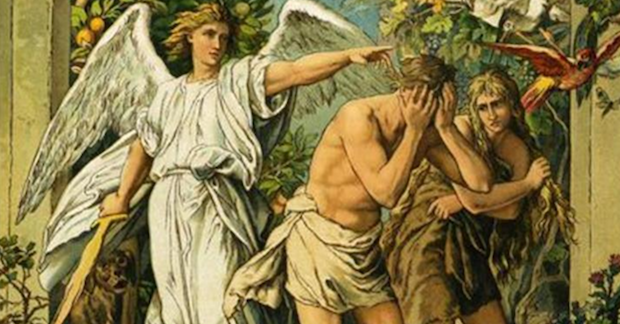

the transgression of Adam,” continued to pay the “death” penalty for that original sin.  Of course, Paul is comparing and contrasting the sin of Adam (and its consequences to all Adam’s “earthly” offspring) to the righteous act of Jesus, dying on the cross (and its consequences to all Jesus’ “heavenly” offspring).  The penalty for Adam’s original sin was not, incidentally, hell, but rather, death—a penalty that is still being paid by every one of Adam’s earthly offspring, to this day—those who are born of the water (semen).  Jesus, on the other hand, according to I Peter 3:18 (NKJV), “suffered once for sins, the just for the unjust . . . being put to death in the flesh but made alive in the Spirit.”  I Corinthians 15:22 (NKJV) states: “For as in Adam all die, even so in Christ all shall be made alive.” 

The most important term in the I Corinthians passage is the word “in” (“in Adam” and “in Christ”).  The Greek word for “in” is spelled “en/ἐν.”  This two-letter Greek word forms the first part of the Greek word entelechy/ἐντέλεχεια, where it indicates “preexistence.”  The way Paul seems to describe it, we all ACTIVELY participated in the sin of Adam (when we were “in” his loins) in the same way Levi paid tithes “in” the loins of his Great-Grandfather Abraham.  In the “semen existing in the loins of the father” analogy, just cited, Jesus and God might have been “one” (“in” God the Father) in the Beginning; then have become “two,” with each retaining His preexistent claim but not necessarily an equality claim.  The argument advanced by Jesus in Mark 12:35-37 (also in Matthew 22:41-45 and Luke 20:41-44, NKJV) seems, however, to convey an equality or even superiority by a “son” over his “father”:  

How is it that the scribes say that the Christ is the Son of David? For David himself said by the Holy Spirit: “The Lord said to my Lord, ‘Sit at My right hand, till I make Your enemies Your footstool.’” Therefore, David himself calls Him ‘Lord’; how is He then his Son?”

For that matter, it is clearly taught that Jesus, the “son of Adam, the son of God” (Luke 3:38) is far superior to his “father” Adam, but not to his Father God?  Would such a biological phenomenon (“earthly thing”) solve the theological issue (“heavenly thing”) pertaining to Jesus’ and God’s equality/subjection or preexistence/subsequence in John’s Gospel?  Not completely.  Let’s look at John 1.

ἐν

The Logos Hymn in John 1

The Greek word “en/ἐν” is also the first word of the Gospel of John, which I think relies on Aristotle’s “earthly” concept of entelechy/ἐντέλεχεια.  I will be explaining entelechy/ἐντέλεχεια in future posts.  For now, I point to the fact that, according to John 1, both God and the Logos existed simultaneously in a scene that has been (incorrectly, I think) translated “in the Beginning.”  Keep in mind that John did not use the explicit term “Jesus” or “son” when he first said that “en archē” (ἐν ἀρχῇ) was the Logos.  The first two words of John’s Gospel are the Greek words “en archē” (ἐν ἀρχῇ).  While a word study of “Logos” is also needed, the words “en archē” (ἐν ἀρχῇ) have very deep meaning in Aristotle’s concept of entelechy/ἐντέλεχεια.  I will consider the meaning of all of these terms (and, certainly, others, such as “light” and “only begotten”), in future posts, as we progress in this series.  For now, consider the amoeba/protozoa analogy alongside the “loins of the father” analogy.  Just as both “daughter cells” preexisted as one amoeba/protozoa, and were ACTIVE together, so God and the Logos are presented as being preexistent together and equal “en archē” (ἐν ἀρχῇ).  The Father/Son relationship, however, is not introduced until the 14th verse of chapter one. There, the “loins of the father” analogy may contribute to an understanding.  We have just begun to scratch the surface of the Gospel According to Entelechy.  Stay tuned.

Sunday, September 6, 2020

Apocalyptic? #9: Revelation 1:1-3 Commentary


Writing from the Isle of Patmos (pictured above):

1 “The revelation from Jesus Christ, which God gave him to show his servants what must soon take place. He made it known by sending his angel to his servant John, 

2 who testifies to everything he saw—that is, the word of God and the testimony of Jesus Christ. 

3 Blessed is the one who reads aloud the words of this prophecy, and blessed are those who hear it and take to heart what is written in it, because the time is near.”


(Revelation 1:1-3 NIV)


Are you ready to “take on” what the dean of all Revelation scholars, R.H. Charles, has called “the most difficult book in the entire Bible”?  Dr. Charles began his Lectures on the Apocalypse for the British Academy in 1919 with the words:  "From the earliest ages of the Church, it has been universally admitted that the Apocalypse is the most difficult book of the entire Bible.  School after school has essayed its interpretation, and school after school has in turn retired in failure from the task."  Nevertheless, using principles culled from the writings of more recent scholars of Revelation, over the past 100 years, fully understanding Revelation is very possible.  I have attempted to prepare you for this daunting task with my first eight posts in this series:

Apocalyptic?  #1:  The End introduced Jesus and God as the Alpha and Omega, the First and the Last, the Beginning and the End.  Before John penned these words in the Book of Revelation, the Greek philosopher Aristotle coined a word—entelechy/εντέλεχεια—to describe any process that has a beginning, a middle, and an end.  Although I began this series with a look at YOUR END, the human drama John sees had its beginning in Creation (Genesis 1-2) and its end in a New Creation (Revelation 21-22).  God is there at both the beginning and the end.  He is also there at every point in the middle—even the point at which you and I are living (and dying).


Apocalyptic?  #2:  Reading Revelation through the Mirror showed you how to read this book, in light of the entelechy John is unfolding.  Entelechies (the one in Revelation, included) are frequently mirror images.  If the same person is BOTH the First AND the Last, BOTH the Beginning AND the End, we can visualize a single person looking into a mirror.  The individual appears BOTH Outside the mirror AND Inside the mirror as equidistant images of the VERY SAME INDIVIDUAL.  I showed you that the book of Revelation is a mirror image of everything that had happened before John wrote the book, and that the key to understanding the book is to look at the future through the mirror of the past.

Apocalyptic?  #3:  The Mirror Image of the Week showed you that one of John’s major mirror images is the Creation “week”—which lasted 7 “days.”  John takes us to Daniel 9 and makes much of the fact that, in 69 A.D. (when John is writing), his audience was living in the MIDDLE of the last WEEK of years (7 years) prophesied by Daniel:  “And he shall confirm the covenant with many for one week (7 years): and in the midst of the week he shall cause the sacrifice and the oblation to cease, and for the overspreading of ABOMINATIONS he shall make it DESOLATE, even until the consummation, and that determined shall be poured upon the DESOLATE”  (Daniel 9:27).  Daniel’s prophecy of the ceasing of the sacrifice was fulfilled in 70 A.D., as the Romans destroyed the Jerusalem Temple.  The Roman War against the Jews had begun in 66 A.D. and would last for SEVEN years (3 ½ more years)—until 73 A.D. 

Apocalyptic?  #4:  The Week that Lasted 7000 Years cites Revelation 20:2 (NIV): “He seized the dragon, that ancient serpent, who is the devil, or Satan, and bound him for a thousand years.”  With his mention of the 1000 years in which the Dragon is confined to the Abyss, John raises the specter of the Cosmic Week (7000 year human history) discussed by the School of Elias.  The German scholar, Paul Billerbeck, observes that, according to the school of Elias, humankind would exist on earth for a total of six thousand years, followed by the 7th day (Sabbath), i.e., eternity in the New Heavens and New Earth. 


Apocalyptic?  #5:  The 7000 Year Drama and the 3 Women introduced a breakdown of the 7000-year-long week into 3 segments of 2000 years each, with each 2 day (2000 years) represented by a metaphorical woman at war with a metaphorical dragon.  The first woman, Eve, represented the time from Adam to Abraham.  That time was PAST, when John penned his book.  The second woman, Israel, represented the time from Abraham to the birth of Christianity and the 7-year-long war between the Jews and Romans (from 66-73 A.D.).  That time is now PRESENT (for John’s audience), but its END IS NEAR.  The third woman, the Church, is preparing to be rescued from the world, and to rule with Christ for more than a thousand years.  That time is still FUTURE (for John’s audience), but its BEGINNING IS NEAR.

Apocalyptic?  #6:  The Divorce of God (7 Seals) points to God saying in Isaiah 50:1 (See also Jeremiah 3:6-10): “Where is the bill of your mother’s divorcement, with which I have put her away?” Isaiah and Jeremiah were prophesying a time when God would divorce Israel.  Catching the attention of Israel was the goal of the Seven Seals of Revelation.  He wanted to warn Israel that (in 69 A.D.) she was in the process of being DIVORCED, to give her the chance to repent.  J. Massyngberde Ford observes: “The Hebrew document which resembles the apocalyptic scroll most closely is the get mequssar, the tied (folded and sealed) deed [used by] . . . priests who wished to divorce their wives.”


Apocalyptic?  #7:  The Number 666 and the Friday Fixation enlightens us concerning the SIXES in Revelation (including the ominous number 666 [Revelation 13:18]). John is using what Kenneth Burke calls the psychology of form to indicate to his audience (in 69 A.D.) that it was on the brink of the “end” of a list of seven.  Something cataclysmal was about to happen.


Apocalyptic?  #8:  ZERO STRESS—Shalom—The New Heaven and New Earth glimpsed the “happy ending” of this vast human drama.  John offers us a glimpse of an existence in which there is no stress at all.  Zero Stress or perfect peace/perfect rest involves experiencing Zero Corporal Stress—no illness, injury, hunger, thirst, pain, tears, death, etc.  Zero Community Stress—no conflict, war, litigation, argumentation, fighting, etc.  Zero Conscientious Stress—zero temptation.  Zero Cash Stress—no money.  Nothing to spend money on. Zero Competence Stress—no difficult tasks required to be done.  Zero Confusion Stress—no sense of being lost.  Zero Chrono Stress: Eternity has no deadlines.


So, now to my commentary:

Revelation 1:1-3:  The Prologue


1
 “The revelation”--The literary genre in which Revelation is placed most frequently is the literary genre "apocalyptic."  Even this placement, however, is not totally satisfactory.  (The genre placement proves itself by itself.)  The genre is actually named for the book of Revelation (Oepke, in Kittel's Theological Dictionary of the New Testament, III, 578).  The Greek word for revelation is apokalupsis from which derive the English terms:  Apocalypse and Apocalyptic.  Thus, the book of Revelation became the paradigm (prime example) for the genre classification "apocalyptic."  There are, nonetheless, both Jewish and Christian "apocalypses" which parallel many of the features of Revelation and at least some of these "apocalypses" borrowed much of their form from Revelation.

“from Jesus Christ, which God gave him . . . He made it known by sending his angel to his servant John.”—John may be the one writing this book, but his Acknowledgements begin with the person who showed him the revelation—Jesus the Messiah—and the person who gave the information to Jesus—God.  John does not mention, in the first sentence of the Prologue, either the other intermediary—God’s angel—or himself, John, perhaps, because, by so doing, he is indicating that he and the angel are less significant than the true authors: God and Jesus.  Indeed, John refers to himself as but a “servant.”


“to show his servants what must soon take place.”  Even though John is but a “servant,” he states that it is, actually, FOR THE SAKE OF God’s “servants” that they are given the revelation.  God and Jesus want their servants to know something about THEIR IMMEDIATE FUTURE: “what must SOON take place,” so that they will not lose faith, but will persist through the tragedies.  R. H. Charles asserts that the close affinity of Revelation to Jewish apocalypses indicates that (like Jewish apocalypses) Revelation should "be taken as referring first and chiefly to the times in which it was originally written" (Lectures, 1).  This assertion by Charles summarizes the position of the CONTEMPORARY-HISTORICAL methodology of interpreting Revelation.  Along with the scholarly consensus, the Contemporary-Historical methodology is the methodology I follow in my interpretation.  Therefore, it is of utmost importance to decide which of the two dating extremes is more acceptable.  The two optional dates are 96 A.D. and 69 A.D.  As you may have noticed in my previous posts, like F. F. Bruce, I am much more persuaded by the 69 A.D. date.  The historical events John describes in Revelation are events that “took place” SOON after 69 began.  Disagreeing with the 69 A.D. date, Adela Yarbro Collins cites evidence from individuals who wrote long after John’s book was written, suggesting that the "date [of writing] [was] about 95 or 96" (Crisis, 76) under the reign of Domitian.  However, she also states that "[t]here is insufficient evidence to warrant the conclusion that Domitian persecuted Christians as Christians" (Crisis, 77).  She points out that many interpreters see Revelation as a response to this situation:  Domitian was persecuting Christians, even forcing them to worship the emperor.  She says this entire scenario is false.  Yarbro Collins claims the crisis addressed in Revelation is more perceived than real.  In other words, she thinks the writer of Revelation was mistaken in his prophecy.  Collins’s view is frustratingly erroneous.  A more elaborate dramatistic analysis and more historical consistency may be found by dating the writing in 69 A.D.  A more consistent and elaborate dramatistic analysis of Revelation is what this blog series attempts to produce.


2 [John] who testifies to everything he saw—that is, the word of God and the testimony of Jesus Christ.  John is not personally “composing” this revelation; he is simply “testifying” to what he “saw.”  In the 7 letters in chapters 2 and 3, he even appears to be taking dictation from Jesus to the seven churches of Asia Minor, much in the same way Silas did for the Apostle Paul, in his letters.  Yet, John clearly uses his own symbol-system (as Kenneth Burke would call it).  John uses his own language in giving his testimony. 

Incidentally, the terms “testifies” and “testimony” are cognates (in the same word family) of the word “martyr.”  The word “martyr” did not originally mean one who is killed; it simply meant one who witnesses.  Later, as the witnesses were slain for their testimony, “martyr” took on the connotation of one who is killed because of his testimony.  John identifies himself along with his "brothers--those having the testimony [marturia] of Jesus—and states that the testimony of Jesus is the spirit of prophecy" (19:10).  Also connected as a cognate of the word “martyr,” then, are the two Witnesses (martusi) that prophecied for three and one-half years, and then lay dead for three and one-half days on the street of the great city where their lord was crucified (11:3,6).

Even though John is only reporting/testifying to what he saw, John’s language is unique.  This fact is actually evidence that only one person (John) wrote the book of Revelation.  Some Revelation scholars have made the mistake of thinking that Revelation was “composed” from several sources.  Although John writes in Greek, he thinks in Hebrew.  His language shows that dual-language mind, throughout the book.  Therefore, correspondence between Greek and Hebrew terms often points to and resolves important issues.  John’s “Hebraized Greek” language may be compared to someone’s unique use of Spanglish (Spanish and English mashed together), in modern day.  Johns unique language is so prominent that Elizabeth Schussler Fiorenza states: “The unitary character of Revelation's language and symbol system argues against . . . an arbitrary dissection of the text" (161).  Throughout her chapter on "The Composition and Structure of Revelation," Fiorenza champions the unity of Revelation:  "The unitary composition of Rev[elation] does not result from a final redactor's arbitrary compilation but from the author's theological conception and literary composition" (159).  Once again, although Fiorenza uses the term “composition,” John is not composing this revelation.  He does, however, choose from his own unique vocabulary the terms of his testimony.  As a lawyer might say to a witness on the stand: “Tell us in YOUR OWN WORDS what happened.”


3 Blessed is the one who reads aloud the words of this prophecy, and blessed are those who hear it and take to heart what is written in it, because the time is near.”  The concept of a Hebrew “blessing” is often misunderstood by modern-day Christians.  Christians say, “Bless this food to the nourishment of our bodies.”  When Jesus “blessed” food, however, he did not actually “bless food.”  He used the words, “Blessed art Thou, O Lord, our God, who bringest forth bread from the earth, the one who created the fruit of the vine.”  Christians say, “Bless this house, O Lord, we pray,” but in the Hebrew mind, we do not ask God to bless food or houses.  Instead, we BLESS PERSONS (especially God)!  John blessed “the ONE who reads aloud the words of this prophecy AND . . . THOSE who hear it and take to heart what is written.”  We bless GOD.  We always give a justification for our blessing:  BECAUSE He brings bread out of the earth; He creates grapes.  For John, the justification for blessing the reader and hearers is this: “BECAUSE the time is near.”  The time is near for what?  John already mentioned it in verse 1: “what must SOON take place.”


More commentary SOON!

Friday, April 10, 2020

Apocalyptic? #3: The Mirror Image of the Week


I am the Alpha and Omega, the First and the Last, the Beginning and the End.

 (Revelation 22:13—See also Revelation 1:8 and 11 and 21:10)


What a week!  As I begin writing this post, it is Friday, April 10, 2020—one of the most sobering Good Fridays in our lifetime, perhaps in Church History. 
This week began on Palm Sunday, with the world-wide church worshiping and celebrating at their homes, due to the lockout of churches.  We in Florida, cut down palm branches and celebrated in our garden.  The entire world is now on lockdown.  Many are experiencing extreme Confusion Stress
(see my book The 7 Cs of Stress), as we find ourselves confused and lost—not knowing if the Pandemic will soon (or ever) end or if the US and world economies will be able to withstand the extreme shock to our economic system that has resulted from our response to the virus. 
Just as the Israelites in Egypt hunkered down in their homes, awaiting the Passing Over of the Death Angel, before the great Exodus, we are hunkered down in our homes, awaiting the Passing Over of the Coronavirus.  Jesus’ disciples were scattered and in hiding, from Good Friday through the Sabbath, as they waited to see if they would be the next to be crucified.  
John’s audience in Revelation faced great Confusion Stress, as well, as they waited, in 69 A.D., to see what would happen next in the Roman War against the Jews that had begun in 66 A.D. (and would last for SEVEN years—until 73 A.D.), as Nero’s Roman army swarmed toward Jerusalem.  Even though John’s audience lived in Asia Minor (the location of modern-day Turkey), they were mostly Jewish Christians who had left the Land of Israel before the War began, but their families and countrymen were still in the Great City of Jerusalem that would soon be destroyed (next year, in 70 A.D.) by Rome.  Five years earlier, in 64 A.D., the Emperor Nero had started the Great Roman Fire, and blamed the event on the Christians, so that nowhere in the Empire was it safe for Christians and Jews to reside, including Asia Minor. 
John makes much of the fact that, in 69 A.D., they were living in the MIDDLE of the last WEEK of years, prophesied by Daniel:  “And he shall confirm the covenant with many for one week: and in the midst of the week he shall cause the sacrifice and the oblation to cease, and for the overspreading of ABOMINATIONS he shall make
it DESOLATE, even until the consummation, and that determined shall be poured upon the DESOLATE”  (Daniel 9:27).  (Daniel’s prophecy of the ceasing of the sacrifice was fulfilled in 70 A.D., as the Romans destroyed the Jerusalem Temple.)  Jesus had prophesied that this predicted “ABOMINATION” of “DESOLATION” would occur before his then-current generation passed away (Matthew 24:34).  And, there, in 69 A.D.—a little less than a “generation”—from the time Jesus spoke the prophecy, John was predicting its fulfillment.  (The standard length of a generation for Jews was 40 years, as in the generation that died in the Wilderness).  John and Daniel express the three and one-half-years—first half (and second half) of this WEEK OF YEARS—in several ways, besides the “midst of the week”:  


“time (=1 year+), times (=2 years+) and half a time (=6 months=3 ½ years)” (Daniel 7:25, 12:7 and Revelation 12: 14)


“twelve hundred sixty days (divided by 3 ½ [years]=360 days, one year)” (Revelation 11:3, 12: 6)

“thousand three hundred five and 30 days (divided by 3 ½ [years]=381.4 days, one year)” (Daniel 12:12)


“forty-two months (divided by 3 ½ [years]=12 months, one year)” (Revelation 11:2, 13:5)


“three and half days (translate ‘days’ into ‘years’)” (Revelation 11:9, 11)


My observation:  From the perspective of THE MIDDLE OF THE WEEK, this WEEK OF YEARS is MIRROR-IMAGED. 
It is chiastic. 
Think of the 7 Golden Lampstands of the Menorah in Revelation.  A visual mirror image.  The first lampstand could represent Sunday; the last lampstand, Saturday.  John saw three and one-half years on either side.  John was helping his audience see history THROUGH THE MIRROR.  We could say that in the analogy of the WEEK OF YEARS, John was writing on Wednesday (hump-day) of that WEEK OF YEARS.  The SABBATH (or 7th day) will be a day of rest for the Christians, just as in the CREATION WEEK, the SABBATH (or 7th day) was a day of rest for God.  After the excruciating Friday Jesus experienced prior to Easter, Jesus rested before his resurrection on Sunday, to begin a brand new era.  Fridays are extremely significant.  What happened on Friday in Creation Week?  God made man in His image.  What happened on Friday before the first Easter?  Jesus was crucified to save mankind. 
I do not know if we are now experiencing another Friday.  As I discussed with my sister Marilyn, I have thought (as she did) of the poignancy of the whole world being in our homes, for this season.  I'm not a big fan of modern-day prophets, but I certainly appreciate the fact that Jesus told us:  "You know how to interpret the appearance of the earth and the sky, but why don't you know how to interpret this present time?" (Luke 12:56).  In the next few posts, I will extend the discussion of the “seven” form beyond the Menorah, the week, and the week of years.  John thinks consistently about the number seven entelechy:  seven churches, seven letters, seven seals, seven trumpets, seven plagues, seven heads on the Dragon and the Beast, etc.  We’ll dive more deeply into the seven entelechy of Revelation in the next post.

Saturday, March 28, 2020

Apocalyptic? #1: The End


I am the Alpha and Omega, the First and the Last, the Beginning and the End.

Ἐγὼ [I AM] τὸ ἄλφα [ALPHA] καὶ τὸ Ω [OMEGA], πρῶτος [PROTOS] καὶ ἔσχατος [ESCHATOS], ἡ ἀρχὴ [ARCHE] καὶ τὸ τέλος [TELOS],

(Revelation 22:13—See also Revelation 1:8 and 11 and 21:10)


Four hundred years before John penned these words in the Book of Revelation, the Greek philosopher Aristotle coined a word—entelechy/εντέλεχεια—to describe any process that has a beginning, a middle, and an end.  The last Greek word in the quotation from Revelation 22:13-- τέλος [TELOS]—is actually found in Aristotle’s term entelechy.  The “TEL” in enTELechy is short for TELOS.  Trillions of everyday processes are entelechies, processes that have a beginning, middle, and end.  A seed being planted, germinating, growing and finally producing new seeds, for example.  A day, beginning at dusk (in the Biblical pattern), proceding to morning, and ending, once again, at dusk.  Water, evaporating from the seas, rising and condensing in the skies, falling back to the Earth as rain, flowing from puddles into creeks, into streams, then rivers, and eventually reaching the seas again.


Your life is an entelechy.  It had a beginning, as you were conceived by your parents.  It has a middle—which you are now experiencing.  It will have an end, whether that end is produced by a coronavirus, an automobile accident, a terrorist attack, or just the limits of old age.  Likewise, God created the existence of humanity as an entelechy.   Humans had a beginning, with Adam and Eve.  They have had a middle—chronicled from the Book of Genesis to the future predictions of Revelation.  They will have an end.  But, like all entelechies, ends are just new beginnings.  The seed that grew and produced new seeds started a new beginning in its seeds.  The day that began at dusk and proceeded through the daylight hours to dusk started a new beginning at dusk.  The water that evaporated from the seas, rose, condensed, rained, and flowed back into the seas started a new beginning, there.  99% of all humans that have lived on Earth have sensed that death is not only an end, but also a new beginning.  There is an afterlife.  And, humanity, which began in Eden, and which will someday end, is expecting a new beginning—a New Heavens, a New Earth, a New Jerusalem, coming out of Heaven from God.


It is fair to question my credentials on this matter.  After all, thousands of theologians have written and taught trillions of words in explanation of the Book of Revelation.  Why should anyone accept the teachings of a seventy-year-old professor at a secular university on this subject?  Please, pardon what may appear to be my lack of humility as I offer you my credentials, but I know that I would never personally trust someone on this subject, unless I knew his or her credentials.  Although I have presented more than a dozen scholarly papers on Revelation, over the years, at regional, national, and international conventions of such learned societies as the Society of Biblical Literature, I have found that biblical scholars have a herd instinct.  If one diverts from the conclusions of the herd, one meets resistance.  For example, I contend that the Book of Revelation was written (as the book itself claims) in 69 A.D., as do F. F. Bruce and John A. T. Robinson.  This dating makes a definite difference in the interpretation of the book, as I will explain in future posts.  The herd, however, believes it was written in 96 A.D. or later.  The herd’s mentality was indicated to me, as I was once introduced at a national convention with words to the effect that Dr. Lindsay contends that Revelation was written in 69 A.D.; the majority of scholars disagree, but let’s “pretend” for the moment that he is right and see what he has to say.  I answered by thanking him for “pretending,” and proceeded to point out that, while mine was the minority position among scholars, it makes more sense than does the majority view.


I do, however, claim to be foremost in scholarship on the subject of entelechy.  My Ph.D. dissertation, at Purdue University, was entitled “The Burkean Entelechy and the Apocalypse of John.”  My department’s graduate faculty at Purdue chose to nominate my dissertation for a national honor:  The Council of Graduate Schools/University Microfilms Dissertation Award.  The University Press of America subsequently published my book Implicit Rhetoric:  Kenneth Burke’s Extension of Aristotle’s Concept of Entelechy and Lehigh University Press published my book Revelation:  The Human Drama, which is a unique approach to Revelation, using the principles of entelechy.  I believe I can offer many interesting insights to the Book of Revelation from this perspective.


Let’s begin, counterintuitively, with the END.  There are numerous articles, sermons, books, advertisements, etc., in the news today regarding what are called “apocalyptic” events.  The Opinion pages of the Wall Street Journal on March 27, 2020 reports: “Though less devastating than World War II, the pandemic has remade everyday life and wrecked the global economy in a way that feels apocalyptic” (https://www.wsj.com/articles/a-coronavirus-great-awakening-11585262324).  The Jewish publication The Jerusalem Post proclaimed on March 26, 2020:  “According to some on social media, the coronavirus is part of the biblical prophecy of the Four Horsemen of the Apocalypse” (https://www.jpost.com/International/Why-do-some-Christians-believe-coronavirus-is-an-apocalyptic-prophecy-622425). 
Those Four Horsemen (from Revelation 6) are Conquest, War, Famine, and Death.  The two World Wars, followed by the attempts of the Soviet Union, China, North Korea, and Communism, plus the attempts of Iran, al-Qaida, and Isis, have allowed the world to witness, in the last century, numerous entities intent on conquest, leading to war.  Pandemics (such as the coronavirus), abortion, and terrorists have produced mass death among the relatively innocent population, but not yet to the same extent as the Bubonic Plague (which killed an estimated 50 million people).  Famines have occurred in the world, but they have often been counteracted by the welfare programs of benevolent nations.  Nevertheless, Conquest as a motive has been a part of the human condition for a long, long time.  The ancient Egyptians, Babylonians, Greeks, and Romans have tried to conquer the world, just as Hitler and Napoleon did in more recent years.  War, unfortunately, has been a near constant throughout the history of mankind.  Famine has seen more powerful effects in years past.  Death, of course, has been a problem for every human, other than Enoch and Elijah, throughout all of history.  So, why do the present circumstances seem apocalyptic?  Revelation does speak of the last plagues, and the coronavirus does seem very much like a plague.  We’ll consider that fact in future posts.  Both Exodus and Revelation speak of a plague of locusts, and we have recently witnessed widespread locust devastation.  We’ll look at that.  Abortion is the killing of innocents on a global scale, so there is plenty of reason for humankind to examine its behavior.  I will, therefore, engage in a series of posts on the subject of Apocalyptic.


For today, however, let’s look at the end/TELOS, not in terms of the end of humanity, but the end of you, personally.  Granted, your personal earthly life could be ended by the coronavirus.  As I have driven some of the deserted highways, streets, and back roads around Walt Disney World, in recent days, I am struck by the fact that, although the likelihood of my death may have been increased, if due to a virus, it has been significantly decreased, if due to an automobile accident.  The roads are safer, much less traveled.  For a portion of my life, as I was working toward the completion of my Ph.D., I was a life insurance agent.  I wrote a book, explaining the rationale behind purchasing life insurance.  It was first published by Oasis Books, under the title The Twenty-One Sales in a Sale.  Now, in its third edition, the title is Making Offers They Can’t Refuse. 
In the book, I point out the incontrovertible fact: “You will die.”  The odds of this happening are 100%.  I used to tell my clients that LIFE insurance is misnamed.  No company can guarantee that you will live.  You won’t.  I told them that the middle name of LIFE insurance is the two letters IF.  There is no IF when it comes to your dying.  You will die, sooner or later.  The only question is WHEN.  So, I take the IF out of LIFE insurance and substitute the letters OV.  I call it LOVE insurance.  The only reason anyone buys it is if there is someone that he or she LOVES.  The one or ones you LOVE will receive the money from the LIFE insurance policy, not you.


Here, then, is the advice I have offered for years, since you will definitely die, but you don’t know when.  Four GETS:

1.  GET RIGHT WITH GOD, so that if you die today from a virus, accident, or anything, your family will not have to worry about your well-being.  Read your Bible, believe that Jesus is the Christ, the Son of God, repent from your sins, confess to others that you believe in Him, and be baptized.  Then, work every day to live closer and closer to his Word.


2.  GET LIFE INSURANCE, so that if you die today from a virus, accident, or anything, you will not have to worry about your family’s well-being.  You need at least 10 times your annual income in life insurance.  At your death, it will come income-tax-free to your family.  They can invest the entire amount and live on just the interest generated.


3.     
GET SAFE.  Don’t take stupid risks with tobacco, alcohol, drugs, dangerous activities.  In the age of the coronavirus, follow the recommendations of the government.  I smile that I wrote the following in my book The Seven Cs of Stress:  A Burkean Approach, page 21, over 15 years ago:  “If the lives of newborn babies can be threatened by what one would consider the clean hands of health care workers, everyone is at risk of corporal stress from the transmission of disease through hand contact.  Sparklingly clean and disinfected restrooms in the home and the office are certainly helpful.   Frequently disinfecting door handles, faucets, flush handles, locks, and railings should reduce disease transmission.  Frequent and proper hand washing, consciousness of the diseases passed by handling paper currency, and being on the lookout for potentially accident-producing circumstances in the home and office reduce other types of corporal stress.  . . . Clearly, everyone at times enters environments that might pose risk for corporal stress.  Even if you wash your hands frequently, you may encounter germs on the door handle as you exit the lavatory.  Consider keeping a supply of alcohol-based wiping cloths at your desk, in your car, wherever it is convenient.  Additional protective measures might include flu shots and pneumonia shots.”


     4.  GET ON WITH LIFE.  You can not possibly know or do everything that could save your life, so just accept the fact that some day the end will come.  Don’t worry about it.  As Jesus said, “Take no thought for your life . . . But seek ye first the kingdom of God, and his righteousness; and all these things shall be added unto you” (Matthew 6: 25-33).  Enjoy your life on Earth.  There is more life waiting for you when it is over.